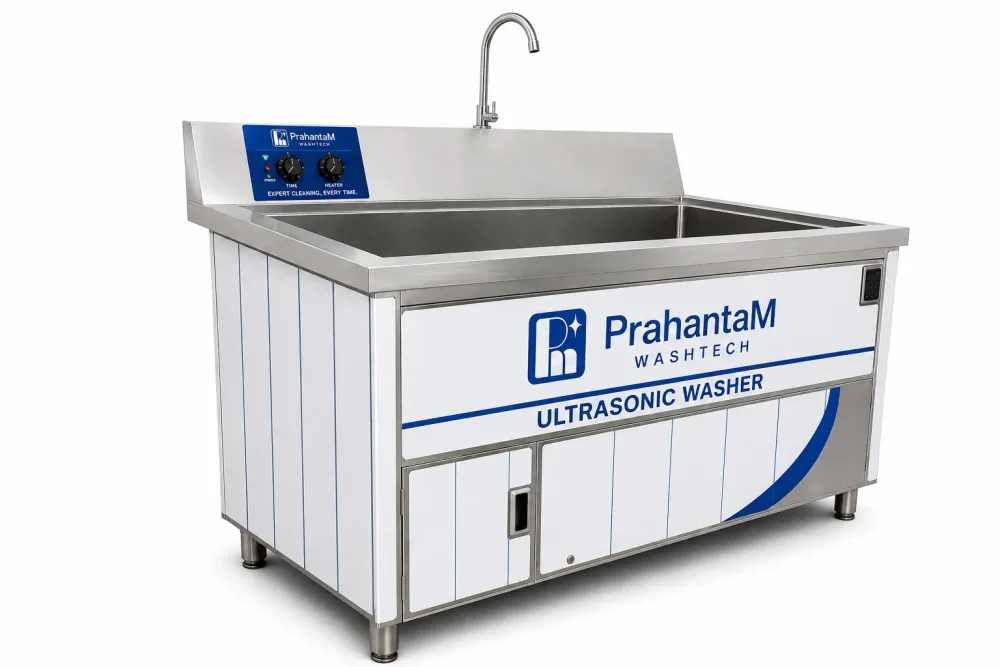
Some soils resist ordinary spray washing: fine mesh strainers, intricate cutlery patterns, delicate glassware with narrow necks, and utensils with hinge crevices. Ultrasonic cleaning uses high-frequency cavitation in liquid to lift contamination from surfaces and blind holes with less manual scrubbing. PM Washtech ultrasonic dish and glass washers bring that technology to commercial kitchens and prep areas across a tank volume range from 6 liters through 230 liters for Indian hospitality and food production buyers.
This overview guide explains how 40 kHz ultrasonic cavitation works alongside optional heating, why ultrasonic processes are often chemical-light compared with heavy spray-detergent lines, who should combine ultrasonic tanks with hood or glass washers, and how to choose among 6L, 10L, 15L and 230L Prahantam models. Manufacturing and support originate from Ahmedabad with practical site guidance nationwide.
What ultrasonic washing solves that spray alone may not
Spray arms excel on open surfaces of plates and racks when loading exposes them to water jets. They struggle when geometry hides soil: shaker tins, micro-perforated skimmers, reusable straw brushes, blender gasket grooves and wine decanters. Manual brushing consumes labor and scratches delicate glass over time.
Ultrasonic transducers emit sound waves through wash liquid, creating microscopic cavitation bubbles that collapse near surfaces and dislodge soil mechanically at a scale brushing cannot reach consistently. At 40 kHz, the process targets fine detail cleaning common in glassware finishing and utensil prep.
Prahantam ultrasonic units are chemical-light relative to aggressive soak-and-scrub workflows because cavitation does much mechanical work. Mild detergent may still help on greasy films, but the method reduces harsh manual chemistry and abrasion on sensitive items.
Who should invest in ultrasonic dish and glass washing
Shortlist ultrasonic when your item mix includes high-value glassware, intricate cutlery, smallware with crevices, or prep tools that must return hygienically without damage. Buyers include hotel stewarding, bar programs with specialty glass, bakery and pastry prep, catering commissaries, institutional kitchens, and industrial food plants cleaning utensils at scale.
Ultrasonic complements rather than replaces hood dishwashers and countertop glass washers in most layouts. Typical architecture: bulk plates through hood or conveyor lines, specialty items through ultrasonic batches.
Very low-volume sites with only flat plates may not justify ultrasonic capital. Sites with recurring complaints about strainer cleanliness or decanter haze often see immediate ROI.
How 40 kHz cavitation works in a wash tank
Transducers bonded to the tank bottom or sides convert electrical energy into ultrasonic vibration in the liquid. Cavitation bubbles form and implode near ware surfaces, releasing energy that breaks bond between soil and substrate. Frequency at 40 kHz is a common commercial choice balancing penetration and gentleness on many glass and metal items compared with lower frequencies that can be more aggressive.
Heating optional on larger models improves grease cutting and can accelerate soil removal when used within manufacturer limits. Heat plus cavitation mimics professional soak tanks without hours of idle time when cycles are sized correctly.
Items must be fully submerged and not nested airtight. Trapped air pockets shield surfaces from cavitation action. Baskets and fixtures help orient ware for exposure.
Range overview: 6 liter to 230 liter Prahantam tanks
6 liter units suit small batches: bar back rooms, pastry corners, office pantry specialty items. 10 liter adds modest capacity with additional transducer count. 15 liter introduces higher ultrasonic power and heating for greasy soils on larger smallware batches. 230 liter industrial scale serves hotels, central kitchens and catering factories cleaning high volumes of utensils and glassware in deep tanks with kilowatt-class ultrasonic power and heat to around 75 degrees Celsius on applicable models.
Choosing tank size is primarily batch volume and item dimensions, secondarily peak timing. A banquet kitchen cleaning fifty decanters nightly needs different geometry than a cafe cleaning six portafilters hourly.
Prahantam advisors map item lists to tank size before buyers overspend on 230L footprint for a small bar or underbuy 6L for a commissary.
Capacity planning and batch workflow
Ultrasonic throughput is batch-based, not continuous conveyor flow. Plan cycle minutes plus load unload time per basket. Peak demand equals number of batches required times batch duration, divided by available tank count.
Duplicate smaller tanks sometimes beat one oversized tank when two prep zones need simultaneous access and walking distance matters in large hotels.
Document which items are ultrasonic-approved versus spray-only. Mixed SOP prevents someone placing aluminum incompatible ware or coated plastics into hot detergent ultrasonics against policy.
Hygiene, food safety and chemical-light operation
Food-contact utensils still require validated wash outcomes. Ultrasonic removes soil mechanically but does not replace organizational controls: separate dirty and clean zones, potable rinse where SOP requires, and periodic microbiological verification for high-risk sites.
Chemical-light does not mean chemical-zero. Use approved detergents at correct dilution for greasy films. Rinse thoroughly before returning items to service or storage.
Change wash liquid on schedule; soil-loaded ultrasonics lose cavitation efficiency and cross-contaminate later batches. Turbidity and odor are operational signals, not cosmetic issues.
Site requirements: power, water, drainage and ventilation
Smaller countertop units need stable benches, electrical supply per nameplate, fill and drain access, and splash control. Industrial 230 liter tanks require floor loading assessment, dedicated power for 3000W class ultrasonic systems plus heating, drain capacity, and staff clearance for safe basket lifting.
Indian ambient temperatures affect cooling after heated cycles; allow time before next load or use controlled fill rates per manual.
Install near prep zones that already handle wet work to simplify plumbing extensions and slip hazard management with mats and grading.
Material compatibility and item care
Glassware, stainless cutlery and many kitchen utensils tolerate 40 kHz ultrasonic with correct basketing. Some coatings, soft metals and assembled items with air-trapped cavities may be unsuitable. Maintain a written compatibility list from manufacturer guidance and your own trials.
Delicate stemware may need shorter cycles and lower heat even when cavitation is gentle relative to steel wool scrubbing.
Operating tips for stewarding and prep teams
Pre-rinse heavy particulate before ultrasonic to extend fluid life. Do not overload baskets; cavitation must circulate liquid. Rotate items mid-cycle only when manual allows and safety permits.
Dry and inspect after cycle; ultrasonic loosens soil that may still need brief potable rinse or air dry on rack.
Assign shift owners for fluid changes and transducer performance checks per audible or visual anomaly training.
Maintenance and transducer longevity
Descale tanks when hardness deposits reduce performance. Avoid dropping heavy tools that damage tank bottom where transducers bond. Follow Prahantam service intervals for industrial units under continuous duty.
Document repairs in hotel engineering logs for warranty and audit trails.
Ultrasonic vs spray dishwashers and glass washers
Spray machines win on plate volume and standardized racks. Ultrasonic wins on geometry, detail and chemical-light delicate care. Most high-end Indian hotel dish rooms benefit from both architectures coordinated by SOP.
Standalone ultrasonic without any spray line suits specialty bars or labs, not full-service restaurants with heavy plate counts.
Why PM Washtech for ultrasonic in India
Prahantam offers scaled ultrasonic solutions from 6L through 230L under one commercial wash brand, simplifying procurement and support from Ahmedabad. Guidance covers Indian water hardness, power variability and staffing realities.
Integration conversations with hood and glass washer lines help buyers build coherent wash ecosystems instead of isolated gadgets.
Reading the 6L to 230L ladder without guesswork
6L at 180W with three transducers serves micro batches. 10L at 240W with four transducers adds mid batch comfort. 15L at 360W ultrasonic plus 450W heating addresses greasy tool cycles. 230L at approximately 3000W with heat to around 75 degrees Celsius serves commissary factory rhythm. Buyers who document item dimensions on one spreadsheet rarely choose twice.
Outlet-level 6L or 10L plus central 230L is a valid corporate pattern for hotel groups: detail at edge, volume at hub.
Chemical-light philosophy without zero accountability
Chemical-light ultrasonic reduces harsh soak exposure for staff and delicate ware, yet approved detergents still belong in SOP where grease demands them. Train teams that chemical-light is not an excuse to skip fluid changes or ignore redeposit on supposedly clean strainers.
Environmental coordinators sometimes favor ultrasonic for reduced detergent volume versus manual brush tubs. Quantify detergent reduction after six months if corporate sustainability reporting requires metrics.
Glassware capital protection
Lead crystal and branded stemware inventories cost lakhs in large hotels. Ultrasonic detail cleaning extends life versus abrasive pads that cloud rims over seasons. Finance should view ultrasonic capital as glassware insurance when event wine programs grow.
Audit questions facilities managers should ask vendors
Ask for loaded-basket performance evidence, not empty-tank demos. Ask how transducer count maps to your largest basket. Ask who services 40 kHz tanks in your city after warranty. Prahantam Ahmedabad orientation answers those from a commercial wash perspective rather than generic industrial catalog language.
Cutlery and utensil detail beyond glass
Hinge forks, serrated knives and perforated serving spoons retain soil in crevices spray tunnels miss. Ultrasonic at 40 kHz across tank sizes addresses those items when material compatibility allows. Stewarding managers should list cutlery complaint categories before assuming new hood machine alone fixes guest complaints.
Chemical-light emphasis helps reduce skin exposure for staff who previously soaked hands in strong detergent tubs hourly. Occupational comfort influences retention in tight labor markets.
Model selection checklist across the range
List items needing detail cleaning with dimensions. Estimate batches per hour at peak. Match to 6L, 10L, 15L or 230L specifications including power, transducer count and heating. Verify floor and power for large tanks. Plan SOP with spray lines. Train staff on compatibility and fluid maintenance. Contact Prahantam for site review and pricing via WhatsApp or phone.
From 6L bench to 230L factory without wrong leap
Buyers sometimes jump from manual scrub directly to 230L because industrial sounds impressive. Stepwise 6L, 10L, or 15L at outlets plus 230L at hub often matches hotel group reality better than single oversize tank at every small kitchen.
40 kHz stays constant across range; power and volume scale. Training from small tank transfers to large tank when SOP vocabulary stays consistent.
Building the item audit spreadsheet
Column headers should include item name, daily quantity, soil class, largest dimension, current clean method, minutes per batch, and failure rate. Sort by minutes lost descending. Top ten rows usually justify ultrasonic tank size choice within one working session with Prahantam advisor.
Revisit spreadsheet after menu change or new banquet package. Ultrasonic need grows silently when cocktail program adds textured glassware or when catering adds chafing dish inserts without updating wash plan.
Next step: item audit and tank sizing with Prahantam
Send photos and dimensions of problem ware, daily batch counts, and available space and power. Prahantam recommends the correct ultrasonic model and documents how it complements your existing dish and glass washing investment.
Detail cleaning at commercial speed protects glassware investment and guest perception. Ultrasonic is the specialist tool that makes that possible without destructive scrubbing.