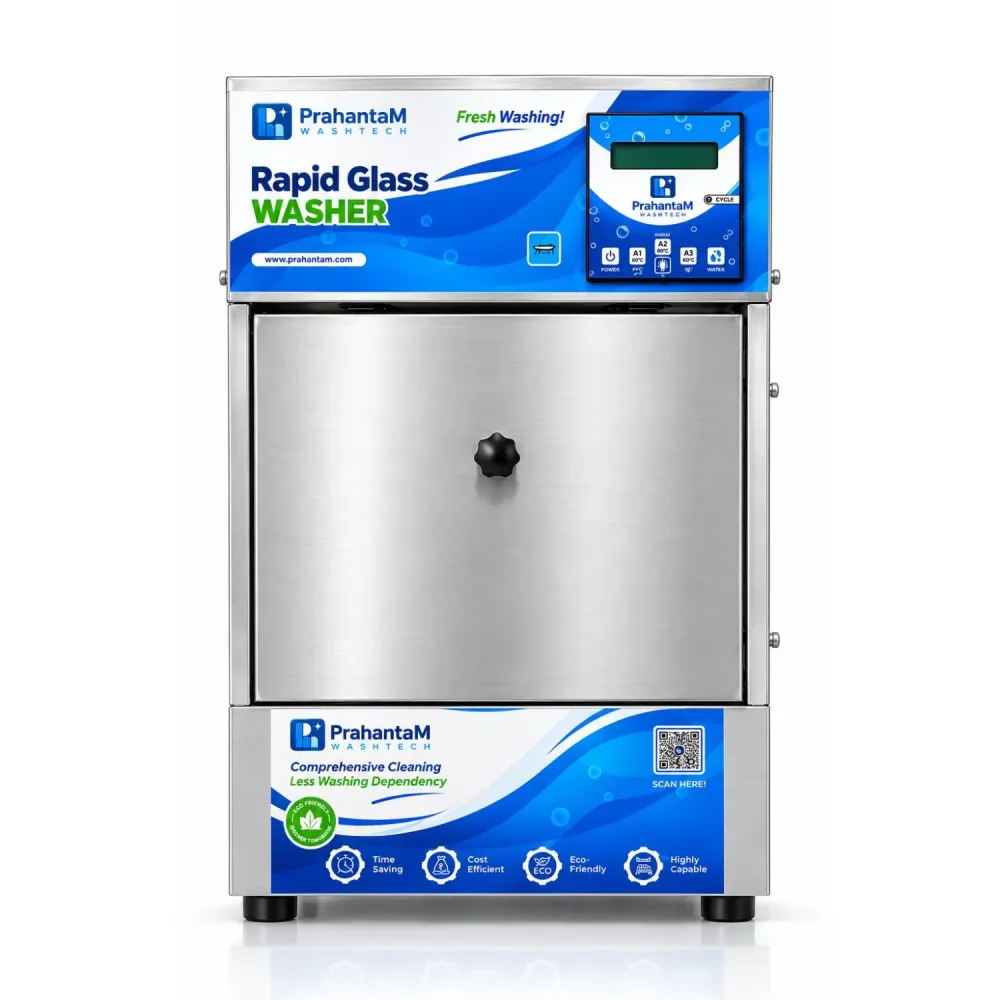
High-volume bars, hotel lounges and event bars live or die by how fast clean glassware returns to the rail. When Friday night demand stacks orders faster than sinks can wash, revenue walks out with impatient guests. The PM Washtech PB02 glass washer is engineered for that environment: larger basket loads, high jet density with 360 high-pressure spray points, and 400 to 650 glasses per hour throughput for busy Indian beverage operations.
This buying guide covers who should choose PB02 over compact PC02 or premium PH03, how jet coverage and basket capacity translate to real bar throughput of 400 to 650 glasses per hour, water use near 2.5 liters per cycle, installation on back bars and service counters, and ownership practices that keep results spot-free under pressure. Prahantam builds and supports commercial glass washers from Ahmedabad for hospitality buyers nationwide.
What the PB02 bar glass washer solves
Busy bars push glassware through soaking, scrubbing and dripping stacks that consume linear counter space and bartender attention. Manual methods break down when three deep orders need fresh pint glasses simultaneously and the sink still holds yesterday slow-cleaning stemware. PB02 automates wash, rinse and sanitize in a commercial cycle sized for heavier nightly volume.
The machine target user is not the ten-seat neighborhood cafe but the pub, club, hotel bar and banquet bar that measures success in covers and repeat rounds. PB02 basket loads between roughly 12 and 22 glasses per cycle reduce how often staff interrupt service to start another wash compared with compact tier machines.
360 high-pressure jets describe comprehensive spray coverage designed to reach interior surfaces when loaders respect basket orientation rules. More jets matter when beer foam proteins, sugary mixers and citrus oils build film that low-pressure domestic washing leaves behind.
Who should shortlist PB02
Choose PB02 when daily glass counts approach or exceed compact PC02 comfortable envelope and when peak hours leave no time for extended manual washing. Typical buyers include city pubs, brewery taprooms, hotel main bars, pool bars, wedding venue bars and large restaurant bars with strong beverage revenue share.
Also consider PB02 when bar layout allows a slightly larger countertop footprint in exchange for fewer cycles per hour to clear the same glass count. If bartenders currently batch dirty glass in bus tubs behind the bar, PB02 gives a defined hygiene path instead of ad hoc sink rotation.
Move to PH03 when hotel brand standards require maximum sanitize temperature headroom for audit documentation or when sustained banquet counts exceed PB02 daily planning near 4000 glasses with no backup machine. Stay on PC02 only if volume honestly remains moderate and space is extremely tight.
How PB02 washing works in practice
Staff dump remaining beverage, inspect for foreign objects, load glasses into the basket without overcrowding, close the door and start the program matched to soil level. Heated wash water with commercial detergent breaks down proteins and sugars. Rinse stages use fresh water to flush chemistry and prepare glasses for service or chilled storage.
High-pressure delivery through numerous jets reduces reliance on manual scrubbing for normal beverage soils. Heavy lipstick, adhesive from promotional stickers or dried smoothie residue may still need quick pre-brush at the counter before load.
Cycle timing aligns with bar rhythm goals similar to the broader Prahantam range near two-minute class cycles for standard programs, subject to soil settings confirmed at commissioning.
Capacity planning: 12 to 22 glasses per cycle and 4000 per day
Basket range 12 to 22 glasses per cycle reflects different glass heights and basket configurations, not an invitation to random stacking. Planning should use conservative glass count per cycle based on your dominant pint or cocktail glass, then multiply by achievable cycles per hour during peak.
Up to 4000 glasses per day is a commercial planning figure when the machine runs across long service windows with disciplined maintenance. Single-night events above normal daily totals may still need temporary backup if they exceed both machine capacity and staff loading bandwidth.
Compare PB02 math to measured spillage and breakage. Bars that lose glasses to chip piles behind the sink may discover capacity problems are partly handling issues, not only washer size. Training often unlocks headroom before capital spend does.
360 jets and spray coverage: what staff must know
Jet count supports coverage but does not forgive nested glasses that shadow one another. Train loaders to angle ware so openings face spray paths and tall items sit where arms reach without blocking neighbors. PB02 rewards bar teams that treat loading like plating discipline, not cramming dishes at home.
Periodic nozzle inspection prevents slow degradation. A partially blocked jet mimics poor detergent choice until someone maps the pattern of unclean spots on glass rims.
Replace or clean spray components per manufacturer schedule and local water hardness reality, not only when the machine fully stops.
Water use near 2.5 liters per cycle and operating economics
Water per cycle around 2.5 liters typically beats uncontrolled tap flow during busy manual washing once staff multitask during rush. Electricity for heating remains the larger utility line item, especially in bars that open afternoon through late night with repeated cycles.
Chemistry costs scale with cycle count. High-volume bars should negotiate detergent supply with dilution control rather than free-pouring concentrate when busy.
Include PB02 in monthly P and L review as labor enabler: bartenders serving drinks beat bartenders standing at sinks when cover counts justify automation.
Hygiene, beer line culture and audit readiness
Bar hygiene is visible to guests who watch glass handling. PB02 gives a consistent wash path that health inspectors and brand auditors prefer over ambiguous sink procedures. Document daily tank rinse, filter cleaning and weekly deep clean assignments with shift names.
Hard water spotting remains the leading complaint in many Indian cities. Rinse aid, correct dosing and descaling protect PB02 performance and guest perception simultaneously.
Separate beer glass policies from general glass if your brand requires it; some operators run dedicated cycles or baskets for beer ware to manage foam retention quality.
Site requirements on back bars and hotel counters
PB02 needs stable counter structure, electrical supply per nameplate, inlet water and drain routing suitable for commercial equipment. Measure door swing clearance in tight back-bar designs before purchase, including overhead glass storage interference.
Ventilation matters when steam exits toward liquor display or electrical panels. New builds should place PB02 within the bartender triangle of wells, rail and washer without creating queue collisions with wait staff.
Event bars in tents or temporary structures need verified power and water stability before relying on PB02 for sole glass hygiene.
Installation and commissioning for bar openings
Prahantam installation guidance helps connect utilities and verify first cycles with local water chemistry. Commission with the actual glass mix and soil from your menu, not only with clean demo ware.
Train opening teams before soft launch. A bar that opens with PB02 but no loading standards will blame the machine for user error during the first weekend rush.
Capture baseline wash results photos for management reference when staff turnover later erodes standards.
Operating tips during peak service
Stage dirty glass in bus tubs, not in the sink with melted ice. Ice dilutes detergent effectiveness and cools pre-wash temperature unpredictably. Run cycles during micro-lulls when possible but do not let dirty glass exceed tub capacity visible to guests.
Keep one bartender backup trained on washer alarms so primary mixologists never leave guests unattended during long cycles.
Polish only when brand requires; unnecessary manual drying after proper rinse aid use wastes seconds per glass during rush.
Maintenance and downtime risk management
Descale on schedule where hardness demands. Inspect door gaskets for tears that leak heat and extend cycles. Stock basic spare parts recommended by Prahantam support for your region.
Festival calendars in India concentrate revenue in narrow windows. Schedule preventive service before Diwali, New Year and wedding season peaks, not after breakdown.
PB02 vs PC02 and PH03 in one view
PC02 fits moderate volume and smallest counters. PB02 fits busy bars needing 12 to 22 glasses per cycle and roughly 4000 daily planning capacity with 360 jet coverage. PH03 fits premium hotel sanitize targets and higher banquet daily counts with about 3 liters per cycle and sanitize up to around 65 degrees Celsius.
Overbuying PH03 in a pub wastes capital; underbuying PC02 in a hotel main bar creates permanent queues. PB02 is the center weight class for beverage-heavy operations.
Why PM Washtech for PB02 in India
Prahantam specializes in commercial glass and dish washing for Indian hospitality rather than repackaging consumer goods. Ahmedabad manufacturing and support shorten response time when a Saturday night depends on jet performance.
Model line clarity helps buyers compare PC02, PB02 and PH03 without unrelated SKUs. Practical advice on water, chemistry and bar layout separates Prahantam from catalog-only sellers.
Cocktail program expansion and soil complexity
Syrups, egg white foam, cream liqueurs and smoked glass rims increase soil complexity beyond beer-only pubs. PB02 jet density supports those programs when loaders pre-brush heavy rims and avoid over-nesting coupe glasses during peak round service.
Menu engineering that pushes high-margin cocktails assumes glass turnaround keeps pace. PB02 belongs in capex conversation when beverage director plans new cocktail launch, not only when sink queue already fails.
Sound, vibration and open kitchen bar design
Open bars expose guests to equipment noise. Place PB02 on isolation pad if counter transmits vibration to guest side. Discuss with interior designer before fixing back-bar joinery around machine envelope and door swing.
360 jets and nightly closing routine
After last call, bar teams tired from service skip jet inspection. Build five-minute nozzle visual into closing checklist tied to cash close so 360 high-pressure paths stay clear for tomorrow foam-heavy sports night. One blocked jet sector mimics detergent failure on only one glass type, confusing debug efforts.
Keep spare rinse arm tools accessible but locked so casual tinkering does not misalign factory settings.
Buying checklist before confirming PB02
Validate daily and peak glass counts against 4000 per day planning. Confirm basket fits dominant glass sizes at 12 to 22 load targets. Measure counter, power, water and drain. Plan hardness treatment and descaling. Train loaders on jet coverage rules. Compare PH03 if hotel sanitize policy requires it. Schedule installation before opening week. Request pricing and WhatsApp support contact from Prahantam.
WhatsApp site pack for PB02 bar projects
Include nightly glass estimate near 4000 per day planning if applicable, photo of back bar with dimensions, list of foam-heavy beer brands, and note if 360 jet PB02 replaces failing import unit. Prahantam Ahmedabad team responds faster with complete pack, moving bar opening or refurb on schedule.
Next step: bar site review and commercial pricing
Send PM Washtech your bar type, glass mix, nightly volume estimate and counter photos with dimensions. Advisors confirm PB02 fit or recommend PH03 or dual-unit strategies, then provide commercial pricing through WhatsApp or phone.
Busy bars deserve equipment that matches their tempo. PB02 is built to keep glassware flowing as fast as the music and menu demand.