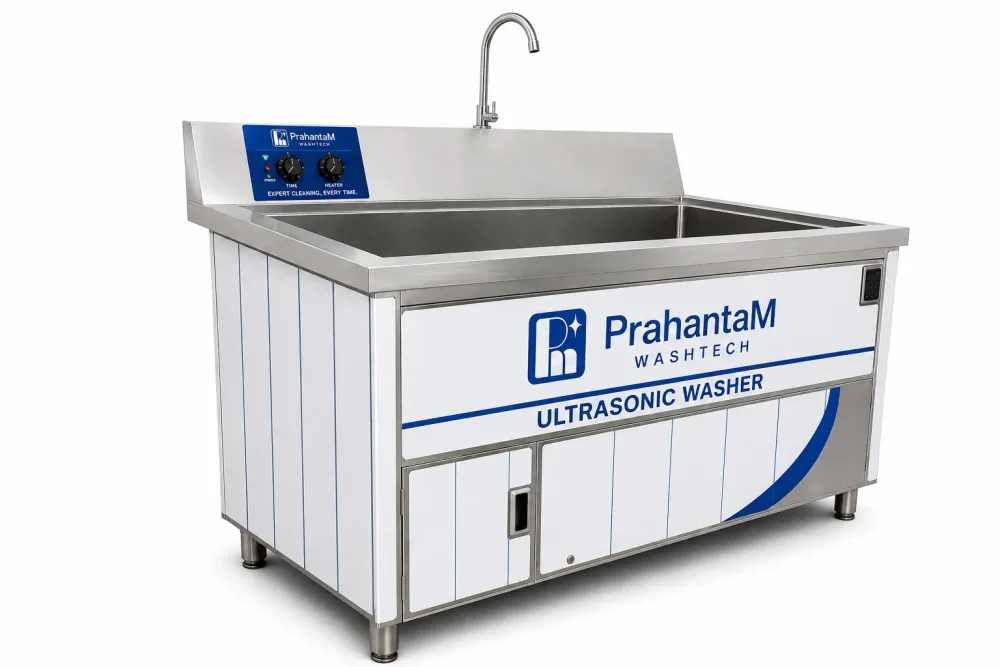
Central hotel kitchens, catering factories and large institutional food production sites cannot clean industrial utensil volume in countertop ultrasonic tanks. The PM Washtech 230 liter ultrasonic washer brings commissary-scale liquid volume, approximately 3000W ultrasonic power, heating capability to around 75 degrees Celsius, and 40 kHz cavitation for deep cleaning glassware, cutlery and utensils in batches sized for serious throughput across India.
This guide addresses facility planners, engineering heads and F&B directors evaluating industrial ultrasonic as complement or supplement to conveyor and hood dish lines, with site power, drainage, safety and staffing implications. Prahantam support and manufacturing base in Ahmedabad serves national deployments.
What the 230L industrial ultrasonic system solves
Large tanks accept baskets of utensils, glass racks and tool sets that would require dozens of small ultrasonic cycles elsewhere. Approximately 3000W ultrasonic power class drives cavitation across the volume when loading follows engineering guidance for submersion and spacing.
Heat to around 75 degrees Celsius supports grease management on heavy production soils while respecting item compatibility limits documented in SOP.
Industrial scale reduces labor hours spent hand-scrubbing strainers, inserts, and prep hardware that spray tunnels miss.
Who should deploy 230L ultrasonic
Hotel central kitchens, airline catering units, large banquet commissaries, food manufacturing plants, hospital dietary production, and institutional canteen factories with high smallware and utensil rework. Not appropriate for bars, cafes or single-outlet restaurants with low batch counts.
Facilities already planning conveyor dish systems should still evaluate 230L for non-rack items rather than forcing awkward loads through hood machines.
How 40 kHz cavitation works at industrial volume
Multiple transducers energize the large bath, creating cavitation fields that reach intricate surfaces when liquid circulation and basket design prevent shadow zones. Cycle recipes balance time, temperature and detergent lightly applied where needed.
Released soil loads the bath quickly at production peaks; fluid management becomes a production planning variable equal to chemical dosing on spray lines.
Capacity and production scheduling
Model throughput by batches per hour times items per basket across shifts. Coordinate with receiving dirty landing from production lines and clean dispatch to storage or spray lines.
Duplicate tanks may be warranted when two production zones cannot share walking distance efficiently.
Peak festival and wedding seasons in India stress commissaries; size for documented historical maximum weeks, not average quiet months alone.
Hygiene and audit expectations
Industrial food sites face strict audits. Document wash temperatures achieved, fluid change intervals, detergent approvals, and separation of dirty and clean flows. Microbiological verification may apply depending on sector.
Chemical-light ultrasonic reduces harsh soak exposure but does not eliminate HACCP ownership.
Site requirements: power, floor, drain and safety
Approximately 3000W ultrasonic plus heating demands dedicated electrical infrastructure verified by qualified engineers for Indian three-phase or nameplate-specific supply. Floor loading, drain capacity, spill containment, and lifting ergonomics for heavy baskets require architectural planning early.
Ventilation and heat management protect staff during long shifts beside heated baths.
Install during build or major renovation when possible; retrofitting 230L into cramped legacy dish rooms often fails ergonomically even if the tank physically fits.
Installation and commissioning at factory scale
Prahantam installation guidance aligns utilities and validates cavitation performance with representative loads, not empty water tests alone. Commissioning records support warranty and audit trails.
Train production supervisors on fluid life, descaling triggers, and transducer protection policies before live production dependence.
Operating discipline in commissaries
Pre-sort incompatible materials at dirty receiving. Use mechanical lifting aids for heavy baskets to reduce injury risk. Change or filter bath on defined soil load metrics.
Coordinate with spray dish managers so clean utensils do not recontaminate in mixed traffic zones.
Maintenance and downtime planning
Descale aggressively in hard water regions. Schedule preventive inspection before national holiday production peaks. Stock critical spares per Prahantam recommendation for your duty cycle.
Downtime cost at commissary scale exceeds capital savings from skipped maintenance.
230L vs smaller Prahantam ultrasonics
6L, 10L and 15L serve outlet and prep niches with 180W to 360W class power. 230L serves factory throughput with kilowatt-scale ultrasonic energy and large geometry. Wrong-sizing down creates permanent bottlenecks; wrong-sizing up wastes capital and floor area.
Integration with hood and conveyor dish systems
Typical architecture: bulk plates and standardized racks through conveyor or hood lines; specialized and high-grease smallware through 230L ultrasonic batches before storage or secondary rinse. Prahantam advisors help map item flows across equipment types.
Why PM Washtech for industrial ultrasonic in India
Local manufacturing from Ahmedabad with commercial wash specialization supports long-term parts and advisory relationships import-only industrial brands may not sustain. Range continuity from 6L to 230L simplifies corporate standards.
Ergonomic lifting and injury prevention
230 liter batches weigh significantly when loaded with stainless inserts and glass racks. Plan hoists, lowering tables or team lift protocols before first production day. Back injuries from improvised lifting cost more than lifting aids capitalized during build.
Non-slip flooring and drainage grates around the tank reduce slip incidents when staff move quickly between hot production and wash zones.
Environmental discharge and local regulation
Commissary discharge may require grease interceptors or municipal compliance beyond equipment purchase. Involve environmental consultant early when soil load is high from frying operations upstream of ultrasonic baths.
Water recycling is rarely built into first purchase but future retrofit may matter for corporate sustainability reporting. Leave plumbing chase space if group engineering may ask later.
Factory acceptance testing with production loads
Before sign-off, run three consecutive batches using actual commissary soil at expected peak weight. Measure time, visual cleanliness, and fluid temperature recovery between batches. Empty water demos mislead procurement committees who never see production reality until opening week panic.
Document acceptance signatures from QA, engineering and F&B so warranty discussions reference agreed performance baseline, not memory.
Corporate standardization across cities
Hotel groups operating Ahmedabad, Delhi, Bengaluru and Goa commissaries benefit from one 230L spec with localized power verification rather than four different import brands with incompatible baskets and spares. Prahantam national support narrative helps corporate engineering maintain one SOP manual.
Redundancy planning for single-tank sites
One 230L tank with no backup becomes single point of failure during pump service. Model cost of four-hour downtime during airline catering departure window versus second tank or contractual emergency manual protocol approved by QA.
3000W ultrasonic field management at scale
Industrial cavitation at approximately 3000W demands respect for loading limits and fluid volume. Shadow zones appear when baskets stack too densely or when oversized trays block energy paths. Production supervisors should treat load diagrams like oven load diagrams: documented, trained, enforced.
Heat to around 75 degrees Celsius assists grease management but increases burn risk for staff leaning over tank without PPE habit. Include heat safety in onboarding alongside knife safety because complacency grows after month two.
Noise and vibration at commissary scale may require hearing protection policy in enclosed wash rooms. Occupational health belongs in capex folder, not only food safety folder.
Integration timeline with conveyor install
When conveyor dishwashers and 230L ultrasonic install in same project phase, sequence commissioning so stewards learn plate flow first, then specialty batch flow. Simultaneous training overloads retention and everyone blames whichever machine they understand least.
Utility trenching should plan combined drain peaks during simultaneous conveyor discharge and tank change events. Plumbing engineer must see worst-case water volume, not average Tuesday.
Supplier and catering contract leverage
Airline and institutional contracts include SLA penalties. Document 230L capacity as part of business continuity plan submitted during tender. Procurement teams score vendors who show equipment redundancy and validated wash SOP.
Buying checklist for 230L approval
Document item list, dimensions and daily batch peaks. Engage engineering on power and floor load. Plan dirty-clean separation and lifting. Define fluid management SOP. Align with existing dish lines. Request site survey and WhatsApp pricing from Prahantam.
Lifecycle cost over ten-year commissary horizon
Industrial tanks amortize across years of twice-daily batch peaks. Spread capital, estimated power for 3000W class operation, heating to around 75 degrees Celsius, water change chemistry, and preventive service across decade model rather than year-one invoice alone. Finance committees approve when ten-year story beats year-three brush labor inflation.
Replacement parts availability from Prahantam Ahmedabad matters more at year seven than glossy brochure at tender submission. Ask explicitly about transducer service pathway and typical lead times before capital release.
Training turnover in commissaries averages high; budget quarterly refresher on load limits and fluid change triggers so knowledge does not walk out with each contract rotation.
Quality assurance sampling after ultrasonic batch
QA should random-sample items from each shift first batch and mid-batch once weekly, documenting pass fail with photos. Trend analysis catches drift before guest-facing failure in airline tray setup or hotel banquet roll-out.
When sample fails, SOP defines whether re-cycle, manual reject, or discard applies by item type. Ambiguity creates silent corner-cutting under time pressure.
Working with Prahantam through tender and install phases
Large catering tenders should attach wash method appendix referencing 230L ultrasonic role, fluid change SOP, and approximate 3000W power need so evaluators score technical completeness. Prahantam Ahmedabad can supply specification language for qualified enquiries without replacing your engineering sign-off.
During install, resist pressure to skip loaded-basket acceptance because production deadline looms. One week delay in commissioning beats six months of arguing whether machine ever met contract.
Post-install, schedule six-month review with Prahantam to adjust descaling interval based on real hardness data collected on site, not supplier generic chart.
Keep WhatsApp thread with site photos for support continuity when original project manager rotates to new property.
WhatsApp and phone enquiry for 230L projects
Send commissary layout PDF, peak batch weights, item photos, and available three-phase or nameplate power details to PM Washtech via WhatsApp or phone. Industrial ultrasonic at 230 liters with approximately 3000W and heat to around 75 degrees Celsius requires site dialogue before quote; early enquiry prevents mismatched tender specifications.
Next step: commissary site survey and pricing
Contact PM Washtech with layout drawings, production schedules and utility capacities for 230L feasibility review and commercial pricing through WhatsApp or phone.
Industrial food production deserves industrial detail cleaning. The 230 liter ultrasonic washer is Prahantam answer when small tanks stop scaling with your operation.