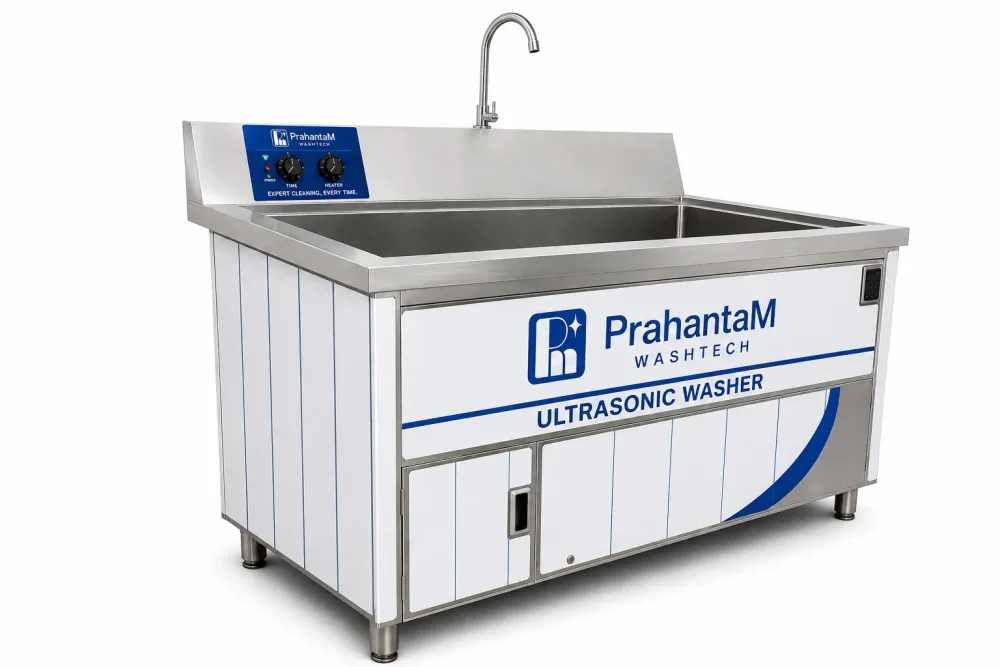
Kitchens that outgrow a 6 liter ultrasonic tank but still do not need commissary-scale equipment often land in a practical middle ground. The PM Washtech 10 liter ultrasonic washer offers 40 kHz cavitation, 240W ultrasonic power and four transducers in a still-compact footprint for stewarding prep, hotel back bars, bakery corners and catering support zones across India.
This guide explains when 10L is the correct step up from 6L, how four transducers change batch coverage, capacity planning for daily smallware volume, site utilities, chemical-light operation, and maintenance with Ahmedabad-based Prahantam support.
What the 10 liter ultrasonic washer delivers
Additional liter volume accepts larger baskets or taller glass pieces while remaining bench-mountable in many dish rooms. Four transducers at 40 kHz spread ultrasonic energy more evenly than three-transducer compact tanks when loads respect spacing rules.
240W ultrasonic power supports faster soil release on typical cutlery, utensils and glassware batches compared with the 180W 6L class, subject to soil and temperature conditions at your site.
The machine remains a batch specialty tool complementing hood dishwashers and glass washers, not a plate volume replacement.
Who should choose 10L over 6L or 15L
Choose 10L when item dimensions or batch counts regularly exceed comfortable 6L loading but greasy volume does not yet demand 15L heating emphasis. Buyers include mid-size hotel stewarding, busy cocktail bars with extensive smallware, institutional prep areas, and cloud kitchen support washing tools and containers between spray cycles.
Choose 15L when heavy ghee-rich or fried soils on utensils dominate and 450W heating paired with 360W ultrasonic on that tier becomes necessary. Choose 6L only when batches stay truly minimal and bench space is extremely constrained.
Industrial 230L targets central kitchens with continuous high volume; 10L is inappropriate for that scale.
How four transducers and 40 kHz cavitation perform
Transducers convert electrical power into mechanical vibration in liquid, producing cavitation micro-jets at surfaces. Four units improve field coverage in the rectangular 10L geometry when baskets do not wall off adjacent zones.
Frequency at 40 kHz balances detail cleaning on glass and metal with commercial durability expectations for daily cycles.
Full submersion without trapped air remains mandatory; cavitation cannot clean dry zones or sealed air pockets.
Capacity and batch planning
Estimate peak items per day grouped by cycle time trials during commissioning. Multiply batches by load unload labor minutes to see if one 10L tank suffices or if duplicate units beat one 15L for split geography in large hotels.
Loading discipline matters more than tank volume. Overfilled baskets mimic underpowered machines.
Schedule ultrasonic batches during prep lulls when possible to avoid competing with hood rack peaks for stewarding attention.
Hygiene, chemistry and rinse practice
Chemical-light ultrasonic still allows approved detergents for oily films. Change wash liquid on turbidity or odor thresholds defined in your SOP, not only at shift end when convenient.
Potable rinse after wash when brand or health policy requires it before food contact storage.
Keep compatibility lists for plastics, composites and coated tools visible at the station.
Site requirements
Bench stability, electrical supply for 240W ultrasonic load plus controls, water fill and drain management, splash containment, and 50 Hz compatibility in India. Allow service access behind or beneath bench as manual specifies.
Ventilation reduces moisture buildup on nearby shelving storing dry smallware incorrectly.
Operating discipline
Pre-rinse particulate from strainers and grater blades. Separate broken glass procedures from tank loads. Standardize cycle minutes posted after soil trials with local water.
Cross-train two stewards per shift minimum so absence does not stop specialty cleaning.
Maintenance
Descale when performance drops in hard water cities. Avoid metal tools striking tank bottom. Log fluid changes and anomalies for Prahantam service calls with useful history.
10L in the Prahantam ultrasonic family
6L offers 180W and three transducers for smallest batches. 10L offers 240W and four transducers for mid batches. 15L adds higher power and heating for greasy soils. 230L industrial scale serves hotel and catering factories with 3000W class systems and heat to around 75 degrees Celsius.
Why PM Washtech
Commercial wash focus from Ahmedabad with scaled ultrasonic lineup simplifies upgrade paths as kitchens grow. Practical advice on combining ultrasonic with spray lines reduces buyer confusion.
Staff safety and ergonomic loading
Ultrasonic tanks contain heated liquid and slippery baskets. Train staff to lift with two hands, keep sleeves clear of splash, and use rubber matting in front of the bench. Tea towels draped over tank edges create contamination paths from dirty pass-through traffic; assign a dedicated landing mat instead.
Jewelry and loose badges can vibrate against glass during cavitation and cause breakage. Simple dress code reminders near the station reduce avoidable loss of high-value stemware during trial programs.
Common mistakes that look like machine failure
Operators often report weak cleaning when the real issue is air-locked hollow handles, overloaded baskets, or detergent concentration changed without notice. Another frequent cause is wash liquid reused far beyond SOP because the tank still looks clear while dissolved grease accumulates in solution chemistry.
Running the 10L unit on an extension cord shared with microwave ovens in office pantries creates voltage drop that reduces ultrasonic performance intermittently. Hardwire or dedicated circuit practice from day one prevents ghost complaints that waste service time.
Integration with hood dishwashers and glass washers
Map item flow on a wall chart: racks to hood for plates, baskets to PB02 or PH03 for service glass, odd tools to 10L ultrasonic. Without that map, stewards default everything to the hood, shadow spray results suffer, and management blames the wrong machine.
Hotel pre-opening teams should rehearse one full service simulation including ultrasonic batches for strainers and inserts before the first live banquet. Discovery during guest service costs more than one training afternoon.
Festival peaks and catering surges in India
Navratri, wedding season and year-end corporate events spike smallware soil without changing tank size. Plan extra fluid changes, stagger batches between prep and stewarding shifts, and keep a backup manual rinse protocol only for overflow, not as default lazy practice.
Caterers moving the 10L unit between sites must re-level the bench and re-verify power each setup day. Vibration walking across loose counters reduces transducer coupling efficiency over time.
Spare support, service and documentation from Ahmedabad
Prahantam support conversations should include your water hardness reading, typical cycle minutes, and photographs of problem items that failed inspection. That context speeds remote diagnosis before a technician visit becomes necessary.
Keep a simple logbook: date, batch count, fluid change, descaling, unusual noise. Six months of honest logs reveal whether 10L remains right-sized or 15L heating tier is the next upgrade.
ROI framing for finance approvers
Finance teams ask payback period. Translate stewarding minutes saved per batch, breakage reduction on delicate glass, and guest complaint reduction on bar glass haze into monthly numbers. Even modest labor recovery often exceeds electricity and chemistry cost for mid-volume hotels.
Compare capital against repeated replacement of domestic gadgets purchased informally by outlet managers and voided after weeks of commercial duty. One approved 10L purchase with warranty path beats three consumer experiments.
Detailed commissioning protocol for 240W four-transducer tanks
Day one commissioning should record ambient water temperature, initial fill time, and basket temperature rise during a standard cycle with typical load. Repeat with lightly soiled glass and with greasy smallware separately because 240W ultrasonic performance feels different across soil classes even at 40 kHz.
Photograph spray shadow patterns only where applicable on hybrid workflows; for ultrasonic, photograph failed items after cycle with loader arrangement visible so future training fixes orientation instead of blaming transducer count.
Store commissioning sheet in engineering binder with serial number, installer name, and Prahantam contact. Hotels undergoing brand reflag within two years still benefit from that paper when new brand auditor asks how specialty cleaning is validated.
Cloud kitchen and delivery-brand prep angles
Delivery-first brands still wash portafilters, sauce dispensers and sealing tools that never touch a guest dining room but still affect taste and safety. 10L fits cloud kitchen back counters where hood dishwashers handle container volume while ultrasonic handles mechanical smallware detail between dispatch waves.
Aggregator rating pressure is indirect, but one viral complaint about foreign object or rancid tool flavor traceable to poor cleaning destroys marketing spend faster than equipment capital cost.
Long-term reliability mindset
Four transducers at 40 kHz are durable when tank bottom stays protected from dropped knife impact and descaling follows water chemistry rather than calendar superstition. Treat the 10L tank like any other production asset with asset tag, depreciation line, and scheduled inspection on annual capex review.
When reliability dips after year three, compare rebuild service versus 15L upgrade if menu shift increased grease. Prahantam continuity means conversation stays with people who know prior model history.
Buying checklist
Confirm item sizes and batch counts justify 10L over 6L. Verify bench utilities. Trial heaviest soil. Document SOP. Request pricing via WhatsApp or phone from Prahantam.
Four transducer field and basket geometry tips
Rectangular 10L tanks favor lengthwise basket placement with tallest items centerline when possible. Four transducers at 40 kHz create overlapping zones; diagonal placement of cutlery baskets sometimes improves exposure versus square cramming.
240W budget shared across load means split heavy and light items into sequential cycles when inspection fails combined load. Data from failed loads teaches more than generic training slide.
Label baskets by zone if bar uses color system for beer versus cocktail glass tools washed non-glass in same tank under strict compatibility policy.
Handoff between stewarding and bar leadership
Bar managers own guest experience; stewarding owns wash outcomes. Ten liter tank at bar back requires written agreement on who buys detergent, who logs fluid changes, and who calls Prahantam support. Gray ownership kills machines slowly through neglect disguised as busy rush.
Monthly joint walkthrough of tank, baskets, and cycle logs takes fifteen minutes and prevents quarterly conflict when audit photo shows neglected station.
Next step
Contact PM Washtech with dimensions, soil photos and daily batch estimates for 10L validation and commercial pricing through WhatsApp or phone.