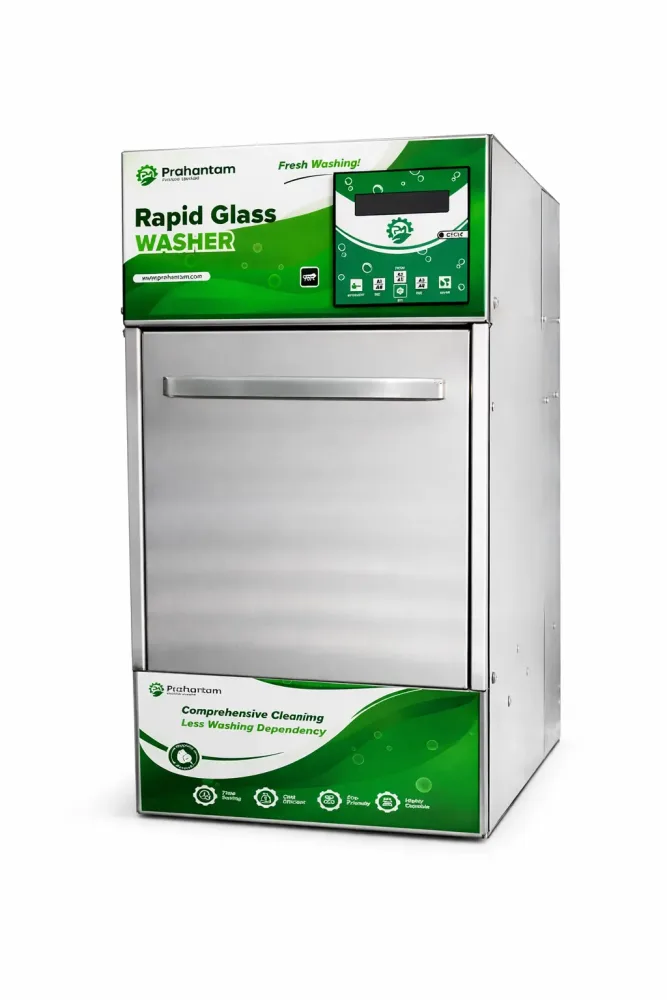
Small cafes, tea stalls, office pantries and boutique hospitality corners need clean glasses without dedicating floor space to a full dish room. The PM Washtech PC02 glass washer is a compact countertop commercial unit built for moderate daily volume, tight benches and teams that cannot afford hand-washing backlog during lunch rush or chai peak hours.
This guide explains who the PC02 fits, how it washes 200 to 400 glasses per hour (up to roughly 2,000 glasses per day in practical planning terms), what basket loads of 6 to 12 glasses per cycle mean for throughput, and why water use around 2 liters per cycle matters for operating cost. Written for Indian buyers evaluating commercial glass equipment with Ahmedabad manufacturing support and straightforward installation requirements.
What the PC02 compact glass washer solves
Domestic dishwashers and sink washing struggle in commercial settings because cycles are long, racks are wrong for bar glassware, and machines overheat or under-sanitize delicate items. The PC02 provides a purpose-built chamber, fixed spray logic and commercial detergents in a footprint that sits on a counter rather than consuming valuable kitchen floor area.
Tea stalls and quick-service cafes often serve hundreds of glasses in a few morning hours. When each glass is washed manually, labor cost and inconsistency rise together. Automating the wash rinse sanitize sequence returns staff attention to preparation and customer interaction instead of standing at a sink.
Office pantries with self-service beverage stations also benefit. Employees expect hygienic cups and glasses without visible residue from previous users. A visible commercial washer supports trust in pantry hygiene programs.
Who should choose PC02 over larger PB02 or PH03 models
Select PC02 when daily glass demand stays within roughly 2000 glasses per day planning capacity, basket sizes of 6 to 12 glasses per cycle are adequate for your rush rhythm, and counter space limits you from wider machines. Typical buyers include independent tea and coffee shops, bakery cafes with beverage service, small hotel lounges, corporate pantry operators and catering prep corners that wash glassware separately from main dish volume.
Step up to PB02 when bar volume, basket load requirements or jet coverage for heavier beer and cocktail soil exceed PC02 comfortable daily envelope. Step up to PH03 when hotel sanitize temperature policy or banquet-scale daily counts require premium heating headroom. PC02 is the entry commercial tier, not a shortcut for high-cover pub operations.
If your primary soil is plates and bowls rather than glasses, evaluate hood dishwashers or combined strategies instead of forcing all ware through a glass-specific basket.
How the PC02 wash cycle works
Operators load glasses into the supplied basket following orientation guidance, close the door and select the appropriate program. Wash stage applies heated water and detergent to remove beverage films, milk proteins and light food soils. Rinse and sanitize stages follow with fresh water to leave glasses ready for air drying or manual polishing if your brand standards require it.
Cycle timing aligns with the broader Prahantam glass range philosophy of quick turnaround suitable for counter service. Exact program seconds vary by soil setting; commission the machine with your typical chai cup or latte glass soil as the reference load.
Water consumption near 2 liters per cycle supports lower utility draw than uncontrolled tap washing, especially in sites where stewards leave water running between glasses during manual processes.
Capacity planning with 6 to 12 glasses per cycle
Basket capacity defines how many glasses move per cycle, not how many you serve per day by itself. Multiply glasses per cycle by realistic cycles per hour your staff can load and unload given counter layout, then multiply by service hours to estimate daily ceiling.
Example planning logic: if you average 10 glasses per cycle and complete 8 cycles per hour during a 4-hour peak, you clear roughly 320 glasses in that window before accounting for off-peak periods. Compare that math to your measured peak day counts from POS or manual tallies before purchase.
Up to 2000 glasses per day is a specification planning figure for sustained commercial use when cycles run consistently across shifts with maintenance discipline. Occasional festival spikes above that may need temporary manual backup or a second unit rather than assuming infinite margin.
Hygiene expectations for cafes, tea stalls and offices
Commercial glass hygiene combines soil removal, rinse quality and sanitize step performance. PC02 programs target hospitality-appropriate results when water quality, detergent dosing and loading discipline are correct. Hard water areas may need rinse aid and periodic descaling to avoid spots that look like unclean glasses to guests.
Tea stalls with sweetened beverages and milk residues should not skip scraping or emptying leftover liquid before load. Spray washing removes film efficiently but is not a substitute for dumping thick leftover into the basket.
Office environments should document daily tank rinse and weekly deep clean responsibilities for facility vendors. Anonymous pantry use increases biofilm risk if cleaning schedules are vague.
Countertop site requirements
Reserve bench space for machine footprint, door clearance and basket staging. Confirm electrical supply matches nameplate requirements for Indian 50 Hz service. Provide potable inlet and a drain path that complies with local plumbing practice for commercial equipment.
Tea stalls in markets may have limited ventilation; ensure heat and steam from the door opening do not condense on electrical panels nearby. Simple stainless shelving above or beside the unit keeps clean glass storage within arm reach.
Mobile cart concepts sometimes mount PC02 class machines for event catering; verify stability and water connections before adopting that pattern routinely.
Operating tips for small teams
Cross-train every shift member on loading angles and program selection so absence of one senior employee does not stall the bar. Keep a small brush at the counter for lipstick or label adhesive on promotional glasses.
Do not nest thick mugs inside delicate stemware unless the basket design allows it safely. Breakage during loading costs more than an extra cycle with proper separation.
Track detergent and rinse aid consumption monthly. Sudden increases often signal water quality change or staff overdosing chemicals thinking more equals cleaner.
Ownership cost for compact glass washing
PC02 occupies a lower capital tier than PB02 or PH03 while still delivering commercial construction. Operating cost centers on heating electricity, roughly 2 liters water per cycle, and approved glass wash chemistry. Labor savings versus manual washing usually dominate the business case in cafes that already employ one or two people primarily for cleanup during peak.
Maintenance includes descaling, gasket inspection and occasional jet cleaning. Budget a service relationship with Prahantam support rather than waiting for catastrophic failure during a holiday weekend rush.
PC02 compared with manual and domestic alternatives
Manual three-sink methods can work at very low volume but fail hygiene repeatability when rush compresses soak time. Domestic dishwashers void warranties and risk fire or flood when misapplied commercially. PC02 is the appropriate minimum commercial step when glass count justifies capital.
Compared with PB02, PC02 trades basket size and daily throughput headroom for smaller price and footprint. Compared with PH03, PC02 does not target maximum sanitize temperature policy for five-star banquet audit folders. Honest volume assessment prevents mismatch.
Why PM Washtech for PC02 buyers in India
Prahantam manufactures commercial wash equipment in Ahmedabad with understanding of Indian cafe and tea stall economics. PC02 is positioned as an accessible commercial entry point without pretending to be industrial dish equipment.
Support includes model guidance, installation orientation and maintenance advice tuned to operators who may be first-time commercial washer buyers. That hand-holding reduces early mistakes that tarnish confidence in automation.
Chai and coffee soil specifics on PC02
Milk proteins and tea tannins film cups differently from beer foam. Run commissioning cycles with your actual cup soil, including sweetened chai residue if applicable. Program selection or cycle habit should reflect that soil, not a generic water-glass test.
Small offices serving instant coffee and herbal tea may see lighter soil but still benefit from sanitize consistency when staff share ware anonymously across departments.
Counter placement in tight retail formats
Tea stalls beside street frontage need secure mounting so vibration does not walk the unit toward the customer edge. Anchor per manual and keep drain hose routed to approved point, not onto sidewalk drainage against municipal rules.
Daily rhythm for up to 2000 glasses planning
Spread 2000 glasses across opening hours rather than assuming even distribution. Morning chai concentration may require continuous cycling 7 to 10 AM while afternoon idles. Staff scheduling should match that curve so one trained operator owns washer readiness at peak.
Track actual cycle count weekly for first month. Data beats intuition when deciding PB02 upgrade before next monsoon season tourist spike.
Upgrade triggers toward PB02
When weekend queues exceed comfortable cycle count, when basket loads consistently max at 12 glasses and still leave dirty backlog, or when bar expansion adds cocktail glass mix requiring more jet coverage, revisit PB02 with Prahantam before peak season rather than after guest complaints.
Approximate 2 liters per cycle and utility tracking
At roughly 2 liters per cycle, multiply daily cycles for water line item in operating budget. Small footprint cafes sometimes ignore utility tracking until landlord bill spikes; early baseline helps compare PC02 honestly against hand washing myth of zero cost.
6 to 12 glasses per cycle means cycle count equals math driver. Teach owners to count cycles during mystery shopper week before blaming machine for slow service when loader pauses between cycles chatting.
Buying checklist before ordering PC02
Count daily and peak glasses realistically. Measure counter space and verify power and drain. Assess water hardness. Confirm 6 to 12 glasses per cycle matches your glass mix. Compare against PB02 if any daily count approaches upper PC02 comfort zone. Plan staff training and cleaning schedule. Request commercial pricing and installation guidance via WhatsApp or phone from Prahantam.
Compact equipment still demands commercial discipline. The PC02 rewards operators who treat it as production gear, not a domestic appliance.
One year of PC02 ownership milestones
Month one: validate cycle and 2 liter per cycle utility baseline. Month three: review peak cycle count versus 2000 per day planning. Month six: descaling or hardness treatment check. Month twelve: decide PB02 upgrade before next peak season if data shows sustained ceiling pressure.
WhatsApp enquiry preparation for faster Prahantam quote
Send daily glass estimate, dominant cup types, counter width photo with tape measure visible, power outlet location, drain path description, and city for water hardness context. Complete enquiry reduces back-and-forth and speeds commercial pricing for tea stall and cafe owners operating on tight opening timelines.
Next step: confirm PC02 fit and pricing
Contact PM Washtech with your outlet type, glass counts, counter dimensions and utility details. Advisors will confirm PC02 suitability or redirect you to PB02 or PH03 if volume or sanitize policy requires a larger tier.
Clean glasses at counter speed keep small hospitality businesses competitive. PC02 exists to make that outcome reliable without oversized investment.